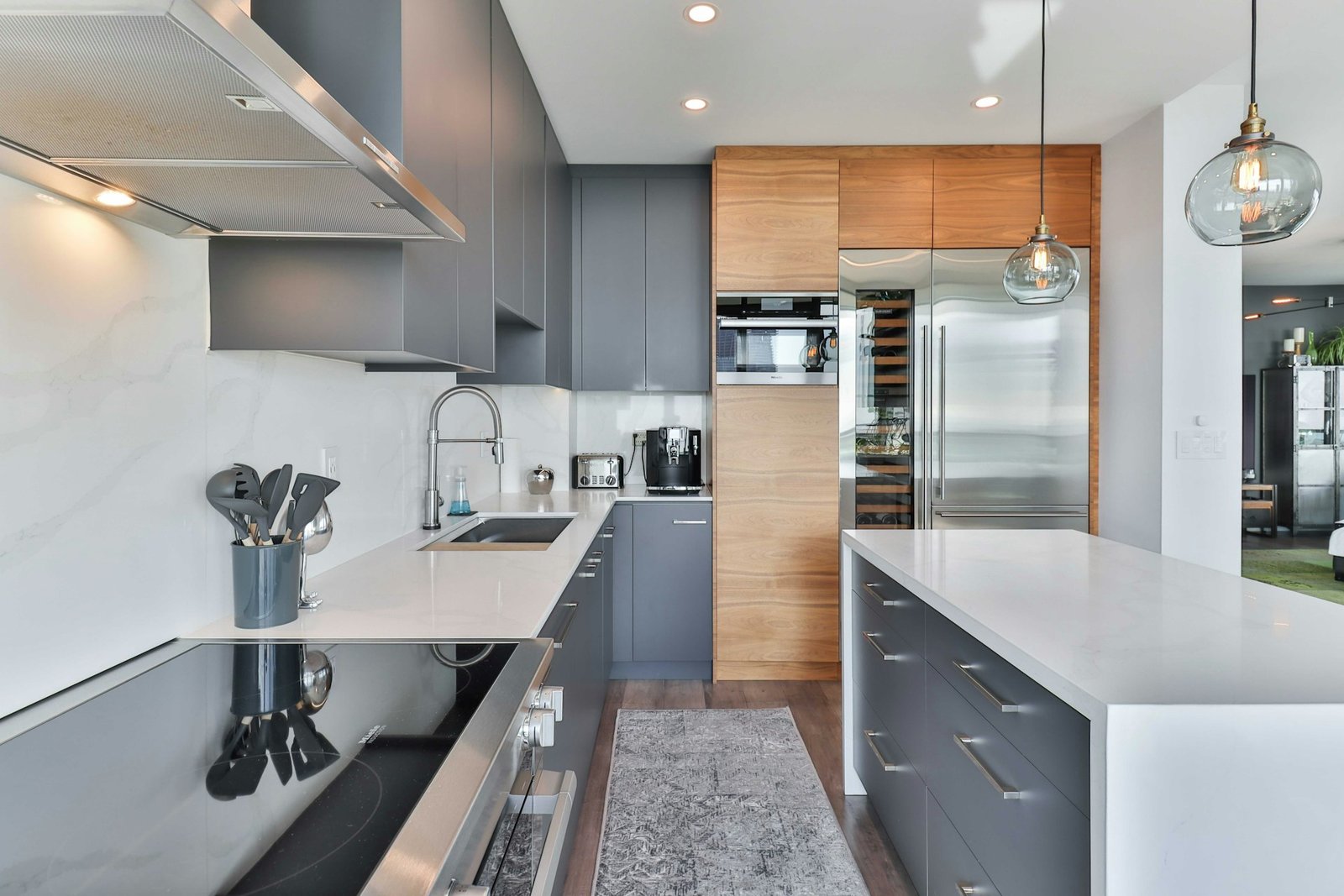
If you’re planning a new kitchen, someone has probably already told you to “just go modular” — and someone else has probably told you a good carpenter can build the same thing for less. Both of them are partly right, and partly missing the point. The real answer depends on what you actually value: speed and consistency, or flexibility and a personal touch.
We’ve built kitchens both ways over the years, so here’s a straightforward comparison, without the sales pitch either side usually gives you.
What “Modular” Actually Means
A modular kitchen is built from pre-engineered cabinet units, made in a factory or workshop to standard sizes, then assembled on site around your exact layout. The carcass, shutters, and hardware are manufactured separately and put together like a kit. This is why modular kitchens tend to have tighter tolerances and a more consistent, factory-like finish.
A carpenter-built kitchen, on the other hand, is constructed largely on site. A carpenter measures your space, cuts the plywood, builds the cabinet frames, and fits everything by hand, piece by piece, right there in your home.
Quality and Finish
This is where modular kitchens usually win, and it’s not really a close call. Factory-cut panels are precise down to the millimetre, so doors close evenly, drawers glide smoothly, and edges line up properly. A carpenter working on site, even a skilled one, is fighting against dust, uneven work surfaces, and hand tools that simply can’t match factory-grade cutting machines.
That said, a genuinely experienced carpenter can still produce excellent work, especially on smaller, simpler kitchens. The gap in quality is real, but it isn’t infinite — it depends heavily on the individual carpenter’s skill and how much time they’re given to do the job properly.
Cost Comparison
This is where the two options are more evenly matched than most people expect. A modular kitchen typically costs somewhat more per running foot than a basic carpenter-built one, mainly because you’re paying for the factory process, branded hardware, and a finished, warrantied product.
But here’s the catch that often gets missed: a “cheap” carpenter kitchen frequently ends up costing more in the long run. Lower-grade plywood, no waterproofing treatment, and basic hinges can mean repairs within two to three years. A fair comparison has to use the same grade of plywood and similar hardware on both sides — and once you do that, the price difference narrows considerably, sometimes to almost nothing.
Timeline
Modular kitchens are noticeably faster. Since the cabinets are manufactured off-site while your existing kitchen is being demolished, installation usually wraps up in two to three weeks from final measurement to a working kitchen.
A carpenter-built kitchen takes longer, often four to six weeks, because everything is built from scratch on site, in sequence, and any mistake means redoing that section by hand. If you’re on a tight timeline, this alone can be the deciding factor.
Customisation
This is genuinely the strongest point in the carpenter’s favour. A good carpenter can adjust a design on the spot, add an odd-shaped shelf around a support beam, or handle a kitchen with unusual dimensions that don’t fit any standard module size. Modular systems are built around standard module widths, so an unusually shaped kitchen sometimes has to work around the system’s limitations rather than the other way round.
Modern modular manufacturers have gotten much better at custom sizing, so this gap has narrowed over the past several years, but for genuinely irregular spaces, an experienced carpenter still has an edge.
Durability
Assuming both use similar quality plywood, a modular kitchen tends to hold up better over time. Factory-applied edge banding is machine-sealed under heat and pressure, which resists moisture far better than the glue-and-iron edge banding a carpenter typically applies by hand on site. Over five to ten years, this difference becomes more visible, especially in humid climates or around the sink and stove.
Hardware is the other factor. Modular kitchens usually come with branded, tested hinges and drawer channels as standard. With a carpenter kitchen, hardware quality depends entirely on what you specify and are willing to pay for — it can be excellent, or it can be a weak point, depending on the budget.
Warranty and Accountability
A modular kitchen company typically offers a written warranty, often five to ten years on cabinetry and hardware, with a documented process if something goes wrong. With an independent carpenter, this is far less formal. Good carpenters do stand behind their work, but there’s usually no paper warranty, and if the carpenter moves on to other projects or areas, follow-up support can become harder to get.
So, Which One Should You Choose?
If your kitchen is a fairly standard shape and size, and you value a consistent finish, a faster timeline, and a formal warranty, a modular kitchen is usually the safer choice. Most homeowners land here, and it’s genuinely hard to go wrong with a reputable modular company.
If your kitchen has an unusual layout, you’re working with a tighter budget and can supervise the work closely, or you already have a carpenter whose previous work you trust, a carpenter-built kitchen can still deliver excellent results.
The one thing we’d steer you away from is comparing a cheap carpenter quote against a premium modular quote and concluding modular is “too expensive.” That’s not really a fair comparison. Ask for the same plywood grade, the same hardware brand, and the same warranty terms from both, and then compare. That’s the only way the numbers actually mean something.
Planning a new kitchen?
Get a free home visit, 3D design and a clear quote — no obligation.
A few questions people often ask: is a modular kitchen always more expensive than a carpenter kitchen? Not necessarily — once you match the plywood grade, hardware brand and warranty terms on both sides, the gap often shrinks to a small amount, or disappears completely. Can a carpenter match modular-level finish quality? A very skilled, experienced carpenter can come close, especially on simpler layouts, but factory-cut precision is difficult to fully replicate by hand. And how long does each option really last? With similar materials, a modular kitchen typically lasts 10 to 15 years with normal use, while a carpenter kitchen’s lifespan depends heavily on the plywood grade and how well the edges were sealed at installation.