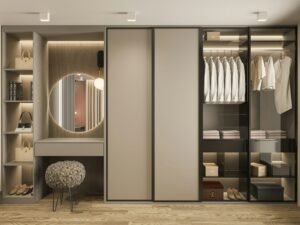
Most homes in Rohini run into the same problem — bedroom size is limited, but the need for storage is exactly the same as in a bigger house. An old steel almirah or a carpenter-made wardrobe from years ago just doesn’t use the space efficiently anymore, and tends to look dated too. A well-designed wardrobe is the practical fix here — more storage in the same footprint, and a better look to go with it.
Here are some practical wardrobe design ideas for Rohini homes, along with materials and real cost numbers.
What to Keep in Mind for Rohini Flats Specifically
Most homes in Rohini are DDA flats or builder floors, where bedrooms usually range between 10×10 and 12×12 feet. At this size, a sliding door wardrobe is almost always the most practical choice, since hinged doors need extra floor space to swing open — space that a smaller room simply can’t spare.
If the room is a bit larger, 12×14 feet or more, a hinged wardrobe with a small walk-in section becomes worth considering too — it gives a more premium feel and easier access to everything inside.
Sliding vs Hinged vs Walk-In
For a focused comparison of sliding and hinged wardrobe doors, see our sliding vs hinged wardrobe guide.
A sliding wardrobe has two or three panels that slide past each other. It’s the best fit for small rooms since it uses zero extra floor space — the only downside is you can only access one section at a time. A hinged wardrobe has traditional doors that swing open, showing the whole interior at once, which makes access easier — but it does need enough room in front for the doors to open. A walk-in wardrobe is a small separate section you actually step into to get things — only really possible in larger bedrooms, but it gives a genuinely luxurious feel.
Materials and Finish Options
For the carcass, or the structure behind the doors, BWP-grade ply or HDHMR board holds up best, especially given how much moisture resistance matters in Delhi NCR’s climate. For the shutter finish, laminate is the most budget-friendly and durable option. Acrylic or PU gives a glossier, more premium look but costs noticeably more and shows scratches more easily. Membrane finish sits in between — a matte look at a mid-range price.
On hardware, it’s worth spending a bit more on good soft-close hinges, channels, and sliding tracks, since these take daily wear directly — cheap hardware tends to loosen within just 2–3 years.
Smart Ways to Organise the Inside
A well-planned interior makes as much difference as the outer finish. Keep long hanging space, for sarees and kurtis, separate from short hanging space, for shirts, since the two need different heights. Add drawer units for folded clothes, undergarments, and accessories — something a basic steel almirah almost never has. A shoe rack section with angled shelving fits noticeably more pairs than a flat shelf would. And a loft or top storage section is useful for things you rarely use — off-season clothes, extra bedding.
What It Costs in Rohini
A sliding 2-door wardrobe in laminate finish, around 7–8 ft wide, typically runs ₹45,000–65,000. A sliding 3-door wardrobe in laminate finish, 9–10 ft wide, costs ₹65,000–90,000. A hinged wardrobe in laminate finish, about 8 ft wide, runs ₹50,000–70,000. Premium acrylic or PU finish adds roughly 20–30% on top of these prices, regardless of type.
These numbers cover the carcass, shutter, and basic hardware. A loft section, mirror, or premium hardware brands like Hettich or Ebco add to the cost depending on the exact layout.
A few things people often ask: which wardrobe design suits a small Rohini bedroom best? A sliding door wardrobe is the most practical choice, since it doesn’t eat into floor space the way hinged doors do — a 2–3 panel sliding design fits neatly into a typical DDA-flat-size bedroom. How long does a custom wardrobe take from start to finish? Usually 15–20 days total — 2–3 days to finalise the design, 10–12 days for manufacturing, and 2–3 days for installation. Is a laminate wardrobe less durable than acrylic? Not really — both last 10+ years with good quality board underneath. The real difference is in look, not durability — acrylic gives a glossier, more premium appearance, while laminate tends to be more matte and slightly more scratch-resistant for daily use. Can a study table be combined with the wardrobe? Yes, and it’s a very common request, especially for a child’s room — a study table and shelving can be built into one side of the same wardrobe unit, making efficient use of the room’s overall space.
Planning a new wardrobe?
Get a free home visit and design ideas for homes across Delhi NCR.